 ☰ Menü
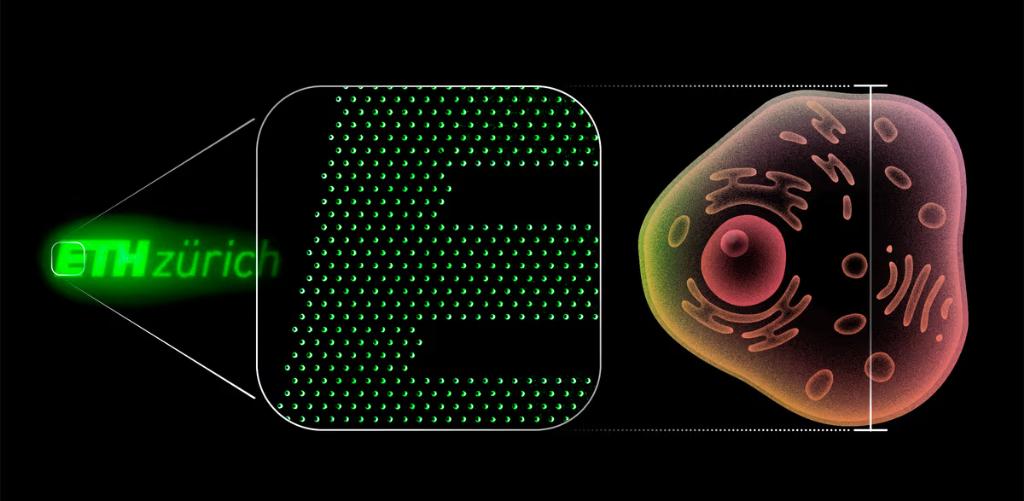
Researchers at ETH Zurich have achieved a significant step forward in the miniaturization of modern lighting technology: organic light-emitting diodes (OLEDs) have been manufactured on a nanoscale for the first time - around 100 times smaller than a human cell.
These nano-OLEDs could not only enable ultra-high-resolution displays, but also fundamentally change microscopy, data transmission, and optoelectronic applications.
A look at the research shows that the future of light will be smaller, more precise, and enormously powerful.
Why is this so important?
• Nano-pixels open up new avenues in microscopy – deeper resolution, better focusing, new imaging techniques.
• Optical interactions between closely spaced nano-OLEDs make it possible to bundle, control, or polarize light.
• Possible future applications include mini lasers, novel sensors, even 3D displays, and holographic applications.
The technological basis for this miniaturization is a new manufacturing process using ultra-thin silicon nitride membranes that can be integrated into existing chip lithography. The results were published in the journal Nature Photonics – a milestone for future optoelectronic developments.
We at the NARVA Trademark Association are observing these advances with great interest - they show how rapidly light and display technology is evolving and what potential still lies ahead.
Read the full article by Lumitos here: World's smallest light-emitting diode manufactured
Image source: Amanda Paganini / ETH Zurich
 Deutsch
 English